
image
Rutuja Dhanale

Tech Hiring

blog image

How Much Does It Cost to Hire a Software Developer in the US, UK, and Australia in 2026? (And What Smart Companies Are Doing Instead). 


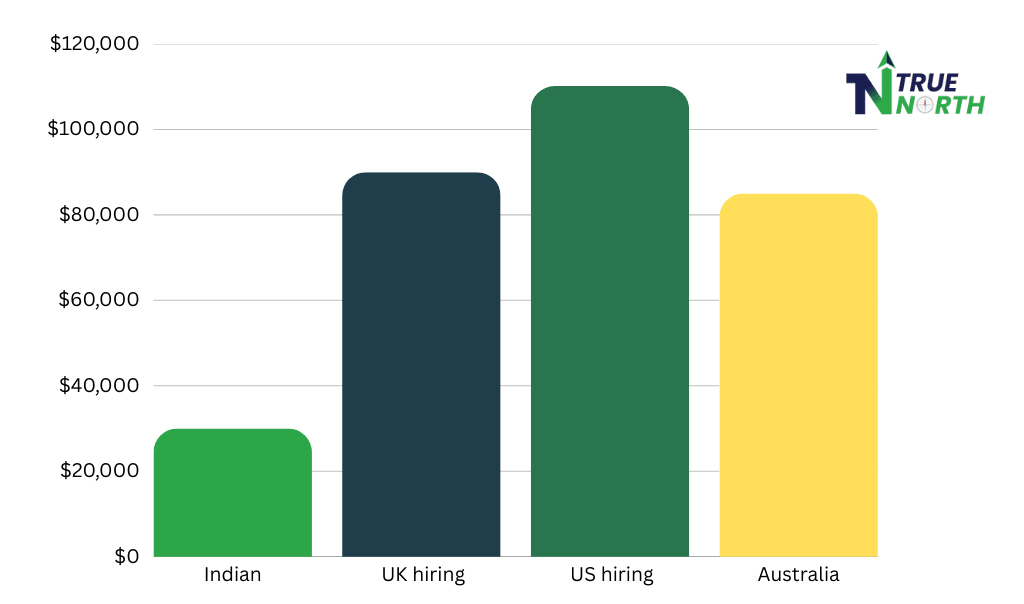
Hiring costs in all countries vs building an offshore team
Hiring costs in all countries vs building an offshore team 

This is a breaks down of the real all-in cost of hiring a software developer in the US, UK, and Australia in 2026, including the hidden costs most hiring managers forget to calculate, and explains why a growing number of CHROs and founders are restructuring their engineering teams around a completely different model.

What Does a Software Developer Actually Cost in 2026? The Base Salary Reality

Before we get to the full picture, here are the base salary benchmarks from current 2026 market data:

United States: The average software developer in the United States earns $110,140 per year according to the Bureau of Labor Statistics, with senior engineers commanding $118,000 to $193,000 annually. In major tech hubs like San Francisco and Seattle, those numbers climb further. Specialised contractors in cloud, AI/ML, and security roles regularly command $150 to $200 per hour, making even short-term contractor engagements expensive for SMBs.

United Kingdom: The average salary for a mid-level Software Engineer in the UK is currently £70,500, while a Senior Software Engineer commands £110,200  figures drawn from the Ravio Compensation Trends report of October 2026. London-based engineers earn meaningfully above these national benchmarks. The UK tech sector faces a significant skills gap, particularly in high-demand fields like AI, cybersecurity, and cloud computing, which has led to a surge in salaries and a greater reliance on contract workers.

Australia: The average salary for a Software Engineer in Australia is AUD $130,000 per year, with top earners reaching AUD $174,548 annually according to Glassdoor data as of early 2026. Cities like Sydney, Melbourne, and Brisbane offer the highest pay, driven by demand in AI, fintech, and cloud computing.

These are the numbers on the offer letter. They are not the numbers on your P&L

The Hidden Costs Most Companies Forget to Calculate

Salary is only the beginning. Every full-time developer hire carries a stack of additional costs that rarely appear in the headline figure.

Employer on-costs add 30 to 50% on top of base salary. Here is what that includes:

In the United States:

      Employer FICA contributions (Social Security and Medicare): 7.65% of salary

      Federal and state unemployment insurance: 1 to 3%

      Health insurance: $6,000 to $14,000 per employee per year, depending on plan

      401(k) employer match: typically 3 to 6% of salary

      Paid time off, sick leave, and public holidays: 15 to 20 days on average

      Equipment and software licences: $2,000 to $5,000 per year

In the United Kingdom:

      Employer National Insurance contributions: 13.8% on earnings above £9,100

      Mandatory pension contributions: minimum 3% of qualifying earnings

      Statutory leave entitlements and payroll administration overhead

      Recruitment agency fee if used: typically 15 to 25% of first year salary

In Australia:

      Superannuation: 11.5% of gross salary, mandatory

      Workers compensation insurance premium

      Annual leave loading and public holiday entitlements

Payroll tax (state-dependent): typically 4.75 to 6.85% of total wages

Market

Base salary

Employer on - cost (+35 %)

Annual Recruitment Fee

Total Year 1 Cost

United States

$120,000

$42,000

$18,000–$30,000

$180,000 - $192,000

United Kingdom

£70,500 (~$88,000)

£24,675 (~$31,000)

£10,575–£17,625

~$136,000 - $155,000

Australia

AUD $130,000 (~$84,000)

AUD $45,500 (~$29,000)

AUD $19,500–$32,500

~$126,000–$143,000

India via TrueNorth

All-inclusive team rate


Included

None

$28,000–$40,000


The full all-in cost comparison for a mid-level developer in 2026 : That last row is not a typo. And it includes everything.

The 90-Day Hiring Timeline Nobody Puts a Price On

Hiring offshore with true north Infotech


The cost of hiring a developer is not only what you pay once they start. It is also what you lose while the seat stays empty.

Average time-to-fill for a software developer role in the US and UK runs between 45 and 90 days when accounting for the full process:

      Job posting and sourcing: 1 to 2 weeks

      CV screening and shortlisting: 1 to 2 weeks

      Interview rounds (typically 3 to 4 stages): 2 to 3 weeks

      Offer negotiation and acceptance: 1 week

      Notice period served by the candidate: 4 to 8 weeks

      Onboarding and productivity ramp: 4 to 6 weeks

By the time your new developer is shipping at full capacity, you have likely crossed the 100-day mark from the moment you posted the role.

Every one of those days has a cost. Delayed features, overloaded existing team members, missed launch windows, and increased attrition risk among the engineers absorbing the extra load.

A dedicated India developer placed through TrueNorth is in your standup within 14 days of requirement confirmation. The 86-day difference between those two timelines is not an operational footnote. For a growth-stage company, it is a product launch.

What Companies Are Actually Doing Instead in 2026

The structural shift happening across US, UK, and Australian tech companies right now is not about cutting corners. It is about recognising that the local market for engineering talent was never designed to serve companies at the 20 to 200 employee stage.

India is a major regional IT outsourcing hub. Businesses can hire experienced developers for $13,000 to $30,000 per year through a direct employment structure. Through a staff augmentation partner like TrueNorth Infotek, that cost covers not just the developer's salary but recruitment, vetting, onboarding support, and a replacement guarantee if the hire does not work out.

The practical outcome for a typical growth-stage company:

      A 3-person India team covering developer, QA, and DevOps costs roughly what a single mid-level US developer costs all-in for a year

      Placement happens in 7 to 14 days rather than 45 to 90 days

      The client interviews and selects every developer personally before commitment

      The team works in the client's tools, attends the client's standups, and follows the client's process

      No employer liability, payroll administration, or HR overhead in India

This is not outsourcing. The client retains full management and control. It is the same developer, differently located, at a fraction of the structural cost.

 If you want to see what that structure looks like for your specific team and open roles, book a 30-minute call with TrueNorth Infotek. No pitch. Just a transparent breakdown of what your team would cost to build.

Frequently Asked Questions

Q: Is the quality of Indian developers really comparable to US or UK developers?

Yes, when the vetting is done right.

India is one of the world’s largest IT outsourcing hubs with the largest English-speaking tech workforce. The real variable isn’t geography it’s screening quality.

Strong offshore teams come from a rigorous vetting process, including:

      Technical assessments

      Communication evaluation

      Cultural alignment checks

Companies that report poor offshore experiences usually skipped proper vetting.

With pre-vetted, dedicated placements through a specialist partner like TrueNorth, that risk is removed ensuring engineers who integrate seamlessly into Western product teams


Q: Are there hidden fees on top of the team rate with TrueNorth?

No. The monthly team rate covers the developer's all-in employment cost in India, TrueNorth's account management, onboarding support, and replacement guarantee coverage. There are no recruitment placement fees, no currency surcharges, and no additional charges if a developer needs to be replaced. The figure on the invoice is the figure you pay.

Q: What is the minimum team size to get started with TrueNorth Infotek?

The minimum engagement is a 2-person dedicated team. There is no minimum revenue requirement or company size threshold. TrueNorth works with bootstrapped SMBs, VC-backed startups, and scaling agencies across the US, UK, and Australia.The one practical requirement is that the client has a technical lead or CTO who can manage day-to-day direction of the team, since staff augmentation is a direct management model, not a project handoff.

If you want to see what that structure looks like for your specific team and open roles, book a 30-minute call with TrueNorth Infotek. No pitch. Just a transparent breakdown of what your team would cost to build.


The real all-in cost of hiring a software developer in the US, UK, and Australia in 2026, including hidden costs most companies miss, and what growth-stage companies are doing instead.

Back to Blog Post

Leave Your Comments

Your email address will not be published. Required fields are marked *